

What's wrong with my fountain?
Pick what your fountain or pond is doing. You'll see the likely cause, what you can safely try first, when it's time to call, and what the repair usually costs.
Updated November 2026
- Free written estimates
- Upfront pricing
- Fountains, ponds and waterfalls
- Homes, HOAs and businesses
Find your problem
What is your fountain or pond doing?
Pump hums but no water comes out
Likely causes: A clogged intake, a jammed impeller, an air lock, or water too low so the pump is running dry.
Try this first: Unplug the pump. Clear leaves and pine needles off the intake, top off the water so the pump is fully covered, then plug it back in.
When to call: If it still hums with no flow, or it feels hot or smells like burning, leave it unplugged. A pump running dry can burn out in hours.
Typical cost: Pump repair usually runs $50–$400; replacement $300–$900.
Fountain won't turn on at all
Likely causes: A tripped GFCI outlet, a failed outdoor timer, a damaged cord or a pump that finally wore out.
Try this first: Press reset on the GFCI outlet, check any timer, and try the pump in a different outlet you know works.
When to call: If the outlet has power and the pump still won't run, or the outlet trips again right away, call us. Don't keep resetting it.
Typical cost: Most of these fixes run $50–$400. A new pump runs $300–$900.
Losing water faster than normal
Likely causes: A crack in the basin, a failed seal where tubing or a cord passes through, or water splashing over the edge.
Try this first: Mark the water level, turn the pump off, and check again in 24 hours. A splashing fountain can lose close to an inch a day in hot, windy summer weather.
When to call: If it drops fast with the pump off, it's a leak in the basin. If it only drops with the pump on, it's splash-out or plumbing.
Typical cost: Crack and seal repairs usually fall within $200–$700.
Green water or slimy algae
Likely causes: Warm, sunny weather plus nutrients from leaves, pollen and fish waste, and not enough circulation or filtration.
Try this first: Skim out debris, scrub what you can reach and run the pump daily. Use a fountain-safe algaecide only if there are no fish or plants.
When to call: If it comes back within a week or two, the fix is a proper cleaning and better circulation or filtration, not more chemicals.
Typical cost: Fountain cleaning runs $150–$450. Pond cleaning visits run $250–$450.
White crust or scale on the stone
Likely causes: Mineral scale left behind as water evaporates. It builds faster when you top off often in summer.
Try this first: Wipe fresh scale with a soft brush and white vinegar on small areas. Never use a wire brush or acid on cast stone.
When to call: Heavy scale inside the pump and tubing chokes the flow and is best handled with a full descaling.
Typical cost: Cleaning and descaling usually runs $150–$450.
Weak or uneven flow over the tiers
Likely causes: A clogged or worn pump, kinked or scaled tubing, a pump that's too small, or a fountain that's no longer level.
Try this first: Clean the pump intake and check that the fountain is level. Uneven water over a lip usually means a tier has shifted.
When to call: If cleaning doesn't bring the flow back, the pump may be worn or undersized for the fountain's height.
Typical cost: Pump repair $50–$400; replacement $300–$900.
Splashing out, loud or noisy
Likely causes: A pump that's too strong for the fountain, flow set too high, or a tier out of level.
Try this first: Turn the flow adjuster down if your pump has one, and check that every tier sits level.
When to call: Constant splash-out drains the basin and can leave the pump running dry, so it's worth fixing properly.
Typical cost: Most adjustments and re-leveling fall within $200–$700.
Fountain lights stopped working
Likely causes: A burned-out bulb, water inside the fixture, a failed transformer or a tripped outlet.
Try this first: Check the outlet and timer first. Unplug before touching anything in the water.
When to call: If the bulb isn't the problem, the fixture or transformer likely needs replacing. LED upgrades last much longer.
Typical cost: Light repairs and replacements usually fall within $200–$700.
Pond smells bad or fish are gasping
Likely causes: Rotting leaves and sludge on the bottom using up oxygen, a clogged filter, or a pump or aerator that stopped.
Try this first: Make sure the pump and any aerator are running, and remove floating debris. Stop feeding the fish until it improves.
When to call: Gasping fish are urgent. A clean-out and filter service usually fixes the cause.
Typical cost: Pond cleaning visits run $250–$450; full annual clean-outs $800–$1,200.
When to stop and call someone
Most of these checks cost nothing, so try them before you pay for a visit. A reset button or a cleaned intake fixes plenty of fountains. Other problems get worse with time: a pump running dry, an outlet that keeps tripping near water, a basin leaking toward your foundation, or pond fish gasping at the surface. Don't wait on those.
When you call, say which symptom matches yours and roughly when it started. A photo or short video helps. You'll get a written estimate before any work starts. The cost guide shows typical prices, and the service pages cover fountain repair, pump replacement and pond problems.
Common questions about fountain problems
Is it safe to work on my fountain myself?
Simple steps like clearing debris, topping off water and resetting a GFCI outlet are safe for most people. Always unplug the pump before putting your hands in the water. Anything involving damaged cords, outlets that keep tripping or wiring should be left to a pro.
How do I know if my fountain pump is dead?
If the pump gets steady power from a working outlet, is fully under water, has a clean intake and still won't run or only hums, it's likely failed. A pump that runs but feels hot or smells like burning is also on its way out.
Why does my fountain keep turning green?
Green water comes from algae feeding on nutrients from leaves, pollen and fish waste, helped along by heat and sun. If it keeps coming back, the fountain needs a deep cleaning and better circulation, not more chemicals.
More ways we can help

Fountain Repair
Pump failures, leaks, cracked basins, weak flow and dead lights on tiered, wall and urn fountains.
Learn more →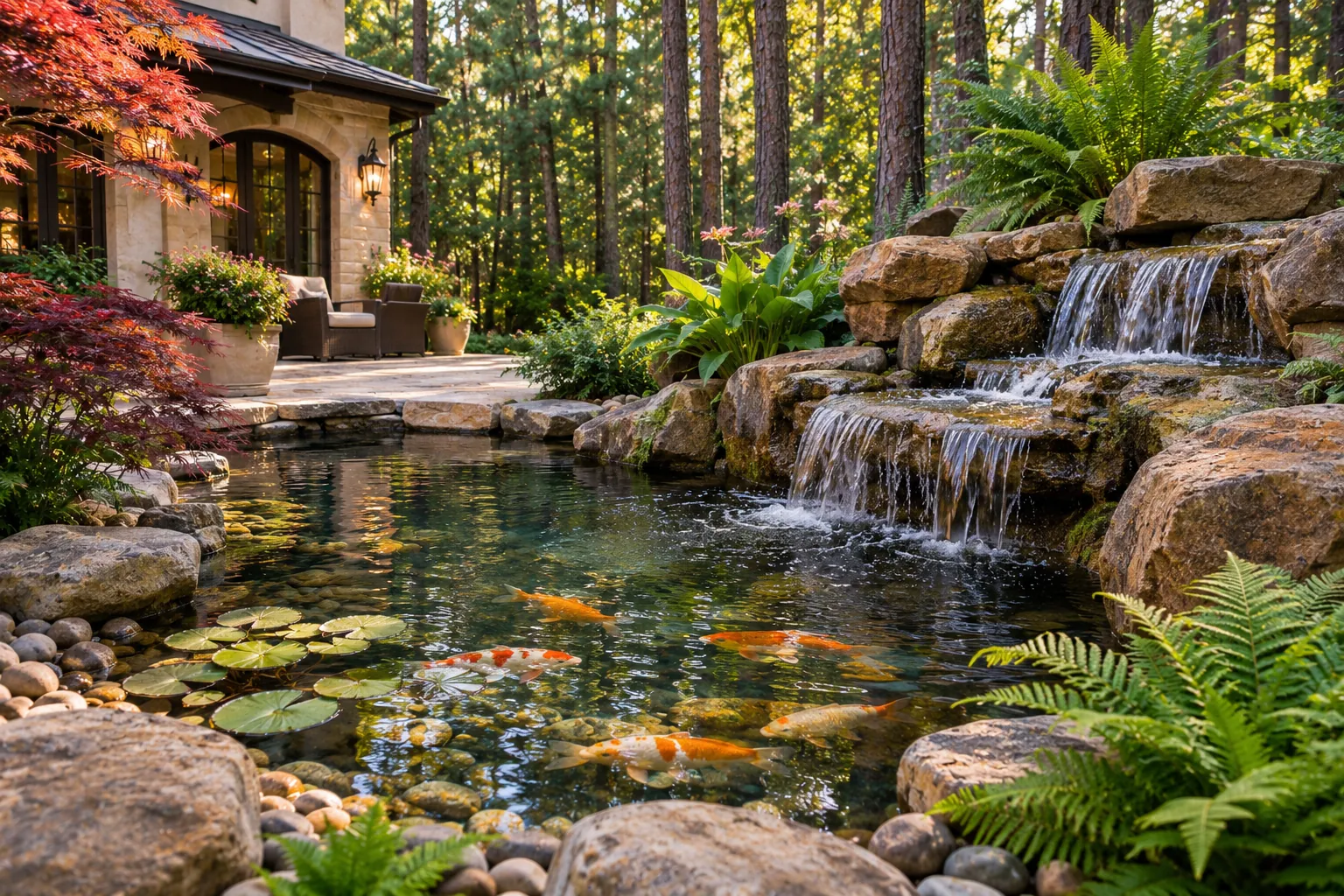
Pond & Waterfall Repair
Koi and goldfish ponds, pondless waterfalls and streams: leaks, green water, pumps, filters and clean-outs.
Learn more →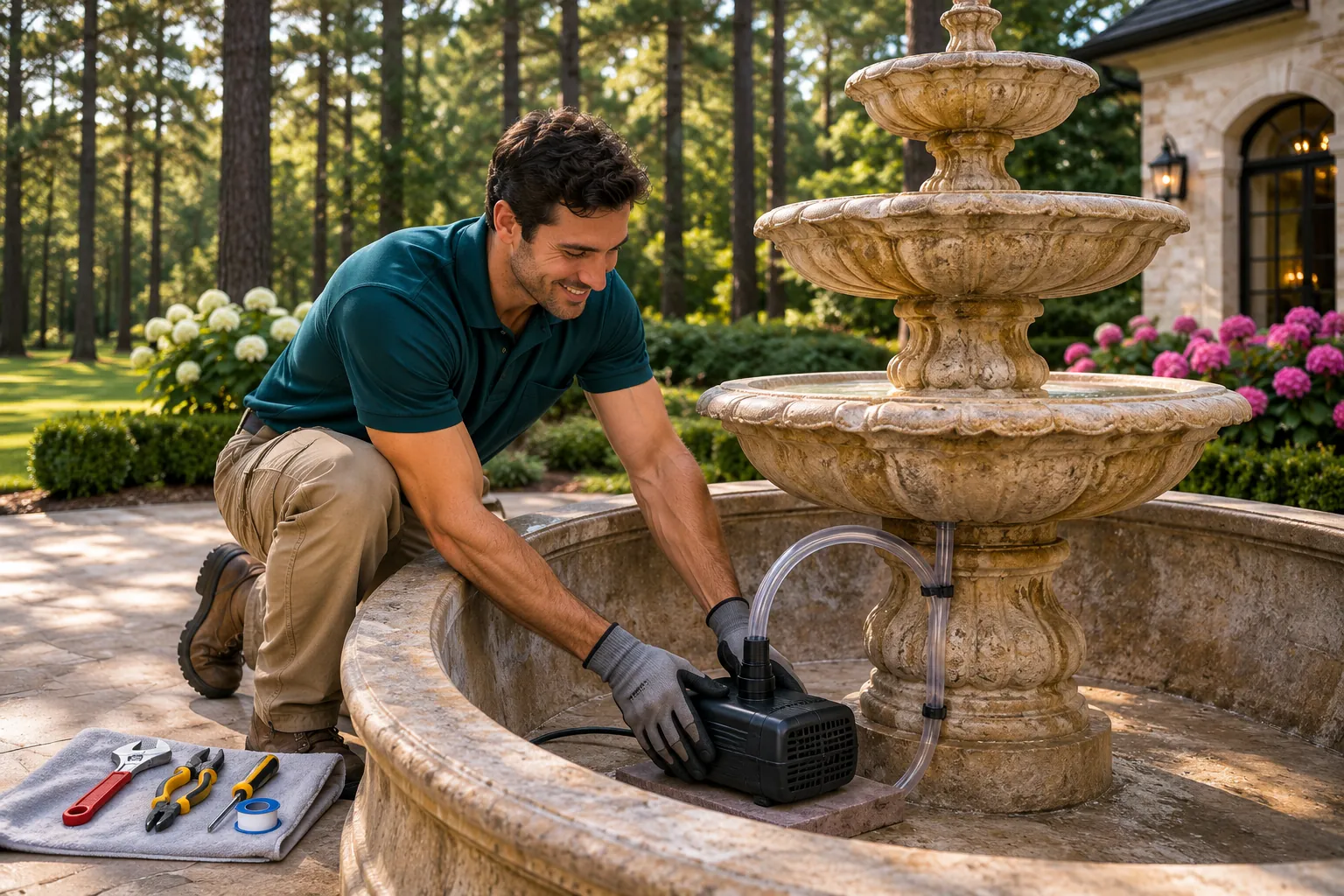
Pump Repair & Replacement
Pumps that hum, trip breakers, run weak or won't start. Cleaned, repaired or replaced with the right size.
Learn more →